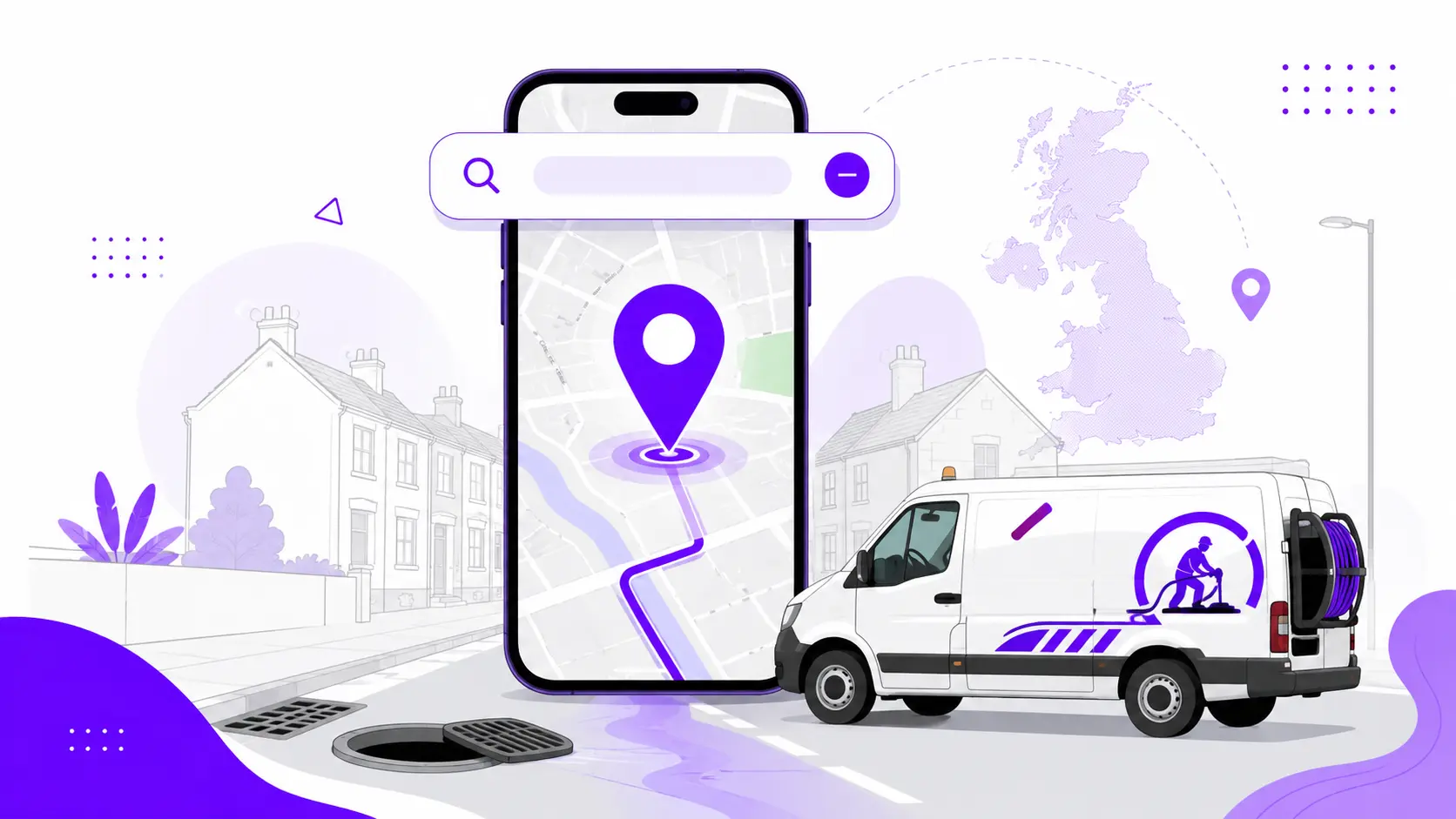
SEO for drainage companies works by combining hyper-local visibility, emergency-search targeting, and trust signals like reviews and accreditations, not by publishing generic blog content. In my experience working with UK trade businesses, drainage searches behave differently from almost any other service category: people search when something’s already gone wrong, and they convert within minutes, not days.
That urgency changes the entire strategy. This isn’t a “publish articles and wait” niche. It’s a “be visible on Google Maps, mobile-ready, and trustworthy within seconds” niche.
I’ve noticed most drainage companies still approach SEO the way a general home-services blog would, long articles, scattered keywords, no clear separation between someone with a blocked drain right now and a property manager planning a CCTV survey next month. That mismatch costs jobs, and it’s exactly what we address in our specialist SEO for drainage companies work.
The data backs this up. Web Tonic’s 2026 plumbing SEO statistics show that plumbing and drainage searches carry strong emergency and near-me patterns, which means ranking for broad, informational terms does very little for actual lead flow. Local Mighty’s local SEO research reinforces the same point, Google Business Profile completeness, proximity, and review activity are consistently treated as stronger ranking and conversion drivers than content volume alone, which is why GBP optimisation sits at the centre of most engagements I run.
In this guide, I’ll walk through what SEO for drainage companies actually means in practice: how to structure service and location pages that convert, how to build the review velocity that dominates the Map Pack, which technical and schema elements genuinely matter, and how to measure success using calls and booked jobs rather than vanity traffic. You’ll see the same pattern play out in one of our own case studies, where fixing on-page and technical issues moved a trades business from page two to the top three results within four months. If you manage or market a drainage business anywhere in the UK, this is the framework I use with clients to turn local search visibility into real, bookable revenue.
What is SEO for drainage companies?
SEO for drainage companies is the practice of optimising a drainage business’s online presence, Google Business Profile, service pages, location pages, and technical foundations, so it appears in front of people searching for blocked drains, CCTV surveys, drain relining, and related services in their exact area. It’s a subset of local SEO, but it behaves differently enough that treating it like generic local SEO usually backfires.
Here’s why that distinction matters. In my experience, drainage search intent splits cleanly into three buckets: emergency, planned, and commercial. Someone typing “blocked drain near me” at 11pm wants a phone number on their screen within seconds. Someone searching “CCTV drain survey cost” is comparing providers before a house purchase or renovation. And a property manager searching “commercial drainage contractor [city]” is often evaluating a supplier relationship, not a one-off job. Digital Scientists’ analysis of SEO for drainage confirms the same pattern, search intent is mainly commercial and local, with users wanting to both win emergency calls and capture higher-value planned work like relining and soakaway installation.
Why Emergency Drainage Searches Convert Faster Than Almost Any Other Trade
This is the part that surprises people coming from other industries. A blocked drain isn’t a considered purchase. There’s no research phase, no comparing five quotes over a week. The customer searches, scans the Map Pack, and calls whoever looks trustworthy and available right now. That’s why Web Tonic’s plumbing SEO statistics research treats calls, not clicks, as the metric that actually matters, traffic without call volume is a vanity number in this niche.
What Makes the UK Drainage Market Different From Generic Local SEO
In the UK specifically, drainage sits alongside plumbing and heating in a competitive local-services landscape, but with added complexity: SuDS (Sustainable Drainage Systems) regulations, Water Regulations compliance, and NADC or CHAS accreditations all factor into how commercial buyers evaluate credibility. I’ve found that drainage companies who treat their website like a Google Maps + reviews funnel, rather than a traditional content-marketing blog, consistently win more of the emergency and planned work that actually pays the bills.
| Search Intent | Example Queries | What the Searcher Wants | How to Win the Search |
|---|---|---|---|
|
Emergency Blocked / flooding drain |
"blocked drain near me", "emergency drain unblocking [city]", "24 hour drainage [city]" | A phone number on screen within seconds — immediate availability, fast response | Dedicated emergency service page, click-to-call CTA, response-time promise, mobile-first speed |
|
Planned Considered / researched |
"CCTV drain survey cost", "drain relining [city]", "soakaway installation" | Pricing clarity, process explanation, proof the job will be done properly | Detailed service pages, before-and-after photos, transparent pricing guidance, reviews |
|
Commercial Supplier evaluation |
"commercial drainage contractor [city]", "SuDS compliance drainage", "surface water drainage [area]" | Compliance proof, accreditations, and confidence in an ongoing supplier relationship | CHAS / NADC credentials, case studies, insurance details, dedicated commercial page |
Why do drainage companies need local SEO?
Drainage companies need local SEO because almost every meaningful lead, emergency or planned, starts with a Google Maps search, not a general web search. If your business isn’t visible in the Map Pack for your service area, you’re invisible at the exact moment someone needs you most. That’s not an exaggeration; it’s how the searches themselves are structured.
Local Mighty’s local SEO research makes this point clearly: proximity, review activity, and Google Business Profile completeness are treated as stronger ranking and conversion drivers than almost anything else in this category. For a drainage company, that means your GBP listing often does more commercial work than your homepage.
Why the Map Pack Decides Most Drainage Jobs Before a Website Is Ever Clicked
The Map Pack, the three business listings that appear above organic results on a local search, is where most drainage jobs are won or lost. Littlenudge’s competitive analysis of the plumbing sector found that businesses holding position one in the Map Pack carry far higher review counts than anything ranking outside the top ten. I’ve seen this exact pattern play out with drainage clients too: the business with the most complete profile and steady review velocity wins the click, even when a competitor has a technically superior website.
Why Emergency Searches Demand Mobile-First, Instant-Contact Pages
Emergency searches are almost entirely mobile, hyper-local, and time-sensitive. Someone with a flooding kitchen isn’t scrolling to page two. They’re calling the first credible-looking result. This is why I always push drainage clients to make their phone number, service area, and “we’re open now” messaging unmissable on mobile, not buried under a hero image or a contact form. Local SEO through GBP and technical mobile performance is what puts you in front of that person in the first place.
Why Commercial and Property-Management Buyers Search Differently Than Homeowners
Not every drainage lead is a burst pipe. Property managers, landlords, developers, and commercial buyers search with more planning and higher expectations, CCTV survey pricing, compliance credentials, service-area coverage. This is where local SEO does double duty: it needs to win the urgent searches and build enough trust and depth to win the considered ones. A well-structured GBP optimisation strategy, paired with genuinely useful service pages, is what lets a drainage company compete for both ends of that spectrum without running two separate marketing efforts.
| Channel | Best For | Typical Conversion Speed |
|---|---|---|
| Organic Search | Planned / commercial jobs, research-stage buyers | Days to weeks |
| Local Pack (Maps) | Emergency and near-me searches | Minutes |
| Paid Ads | Immediate visibility while organic SEO builds | Minutes, ongoing cost |
What keywords should drainage companies target?
Drainage companies should target keywords organised by urgency and service type, not by generic industry terms. In my experience, the biggest keyword mistake I see is a drainage business chasing broad terms like “drainage services” or “drain company” when the actual searches people type are far more specific and far more revealing of intent.
SEOTakeoff’s plumbing SEO guide backs this up, the strongest-performing content in this space is built around a primary keyword cluster that includes terms like “blocked drain near me,” “CCTV drain survey near me,” “drainage company SEO,” and location-modified variants of core services. Each of these signals a different stage of buyer intent, and treating them as one keyword group wastes ranking potential.
Targeting the Emergency Keywords That Convert Within Minutes
These are the highest-urgency, highest-conversion searches you’ll ever target: “blocked drain near me,” “emergency drain unblocking [city],” “drain flooding help,” “24 hour drainage [city].” I usually recommend building a dedicated emergency service page for these terms rather than folding them into a general services page, the searcher’s mindset is completely different from someone browsing, and the page needs to reflect that with immediate contact information, response-time promises, and minimal friction.
Targeting Planned-Service Keywords From Buyers Still Comparing Providers
Planned searches include things like “CCTV drain survey cost,” “drain relining [city],” “soakaway installation,” and “drain jetting services.” These searchers are comparing providers, often reading a few pages before deciding. This is where genuinely useful content, pricing guidance, process explanations, before-and-after photos, earns trust rather than just ranking. It’s also where semantic terms like same-day response, service area pages, and visual proof start to matter for both rankings and conversion.
Targeting Commercial Keywords From Property Managers and Developers
Commercial and higher-value searches look like “commercial drainage contractor [city],” “surface water drainage [area],” or “SuDS compliance drainage.” These buyers. property managers, landlords, developers, are evaluating suppliers, not just solving a one-off problem. I’ve worked with clients where this segment was almost entirely overlooked, and building out even a few well-structured commercial pages opened up contract-level work that emergency-only marketing never touched.
| Urgency Tier | Service Type | Location Modifier Example |
|---|---|---|
| Emergency | Blocked drain unblocking, emergency callout, flooding response | "emergency drain unblocking Manchester", "24 hour drainage Leeds" |
| Planned | CCTV drain survey, drain relining, jetting services | "CCTV drain survey cost Bristol", "drain relining Birmingham" |
| Commercial | Commercial drainage contracts, surface water drainage, SuDS compliance | "commercial drainage contractor London", "SuDS compliance Surrey" |
Reference: keyword clustering built from UK drainage & plumbing local SEO research, 2026.
A properly built content SEO strategy treats these three buckets as separate content and page priorities, not one big keyword list. That structure alone tends to fix a lot of the “we rank for nothing that actually converts” problem I see with drainage sites.
How should drainage service pages be structured?
Drainage service pages should be structured around one service, one clear intent, and everything a searcher needs to book, not a paragraph or two of generic copy stretched across a “Services” page. This is one of the most common gaps I see when auditing drainage sites: a single page trying to cover blocked drains, CCTV surveys, relining, and jetting all at once, which tells Google nothing meaningful about what the business actually specialises in.
SEOTakeoff’s plumbing SEO guide makes a point I fully agree with, the best-performing pages in this space are built around clear service pages, location pages, FAQ blocks, and internal linking rather than long-form informational posts. Each core service, blocked drains, CCTV drain surveys, drain relining, jetting, soakaway installation, genuinely deserves its own dedicated page.
The Core Elements Every High-Converting Service Page Needs
A page built for “CCTV drain survey [city]” needs to answer the searcher’s real questions fast: what the service involves, how long it takes, rough pricing expectations, and why this company specifically should do the job. I usually recommend structuring these around a short intro that mirrors the search term, a clear explanation of the process, and visual proof where possible, before-and-after photos or CCTV stills carry real weight here, something Zava Build’s drainage SEO content does particularly well, using extensive before-and-after imagery and jetting shots to build trust before a single word of copy is read.
The Conversion Elements That Turn a Visit Into a Phone Call
Every service page needs obvious conversion paths, a phone number that’s tappable on mobile, a clear callout for emergency availability if relevant, and trust markers like accreditations or guarantees near the point of decision. This ties directly back to why on-page SEO work matters as much as the content itself: title tags and meta descriptions built around real search terms (“emergency drain unblocking Manchester”) outperform generic business-name-led titles by a wide margin, something we’ve seen play out directly in our own case studies.
Using Internal Links to Connect Related Drainage Services
Service pages shouldn’t sit in isolation. Link the blocked drains page to the CCTV survey page when relevant (“if the blockage is recurring, a CCTV survey can identify the cause”), and link both back to location pages covering the areas you actually serve. This kind of internal structure is what turns a handful of pages into a coherent site Google can understand and it’s a step a lot of drainage sites skip entirely
High-Converting Drainage Service Page Checklist
- Dedicated page per core service (blocked drains, CCTV survey, relining, jetting)
- Title tag and meta built around real search terms, not the business name
- Tappable phone number visible without scrolling on mobile
- Before-and-after photos or CCTV stills for visual proof
- Accreditation badges (CHAS, NADC) near the top of the page
- Internal links to related service and location pages
- FAQ block answering pricing, timing, and coverage questions
Reference: service page structure best practices, UK plumbing & drainage SEO research, 2026.
How should location pages work?
Location pages should exist only for areas a drainage company genuinely serves, not as a mass-produced list of every town within fifty miles. This is one of the most damaging patterns I see in this niche: dozens of near-identical “drainage services in [town]” pages with swapped place names and nothing else different. Google recognises this pattern easily, and it tends to weaken a site rather than help it.
Littlenudge’s local SEO analysis flags suburb-specific landing pages as a genuinely underused opportunity, but only when they’re built with real local substance. The gap between “underused opportunity” and “duplicate content penalty” comes down entirely to execution.
Why Location Pages Should Only Cover Areas You Actually Serve
Before building a single location page, I always map out where the business actually completes jobs, not where it wishes it did. A drainage company that genuinely covers ten boroughs around East London has ten legitimate location pages available. A company stretching that to thirty towns “just in case” is diluting relevance and inviting thin-content problems across the board.
Deciding Between City-Wide Pages and Suburb-Level Pages
For multi-location or wide-service-area drainage businesses, I’ve found a tiered approach works best: a strong page for the main city or region, supported by suburb-level pages only where there’s enough unique local detail to justify a separate page, specific streets or areas known for drainage issues, local case studies, or genuine service-area nuance. If there’s nothing unique to say about a suburb beyond swapping the place name, it doesn’t need its own page yet.
How to Avoid the Thin-Content Trap That Weakens Local Rankings
This is where most drainage sites lose credibility with Google. A location page needs local specificity: mention of nearby landmarks or postcodes genuinely served, any local job examples, and ideally a testimonial or review tied to that area. Thin or duplicated service and location pages are flagged directly as a common and damaging mistake across the drainage and plumbing competitor set, not a minor technical nitpick.
Location Page Decision Matrix
Choosing the right structure for each service area
Branch Pages
Best for distinct sub-areas with real local detail — landmarks, job examples, and genuine service nuance.
Suburb Pages
Use sparingly — only where there's enough unique content to avoid duplicating a nearby page.
No Dedicated Page
The safest default for areas served only occasionally, protecting overall site relevance.
Reference: local page architecture guidance, UK drainage SEO competitor analysis, 2026.
Getting this right is closely tied to the broader technical SEO foundation of a site, duplicate or near-duplicate pages create crawl and indexing issues that can quietly hold back every other page on the domain, not just the location pages themselves.
How does Google Business Profile help drainage SEO?
Google Business Profile is the single most important asset a drainage company has for local visibility, more than the website itself, in a lot of cases. This isn’t an exaggeration. For emergency and near-me searches, GBP is often the first and only thing a potential customer sees before deciding who to call, and it directly determines whether you appear in the Map Pack at all.
Local Mighty’s local SEO guide treats GBP completeness, services, photos, hours, and review activity as the primary local ranking and conversion drivers, ahead of most on-site factors. That matches what I’ve consistently seen with drainage clients: fixing a neglected GBP profile tends to move the needle faster than almost any other single change you can make.
Getting the Core GBP Profile Fields Right From the Start
Getting the fundamentals right matters more than people expect. Accurate business name, correct primary and secondary categories (drainage service, not just “plumber”), consistent NAP (name, address, phone) data matching what’s listed across directories, and precise service-area settings all feed directly into whether Google trusts the profile enough to surface it for local searches. I’ve found that NAP inconsistency across citation sites is one of the most overlooked issues, a slightly different phone number or address format on a directory listing can quietly undermine local trust signals.
Listing Drainage Services and Categories Google Can Actually Understand
Drainage-specific service listings, blocked drain clearance, CCTV surveys, drain relining, jetting, emergency callouts, should be added explicitly within GBP’s services section, not left implied by the business category alone. This also ties into hours and emergency messaging: if a business offers 24-hour emergency response, that needs to be reflected clearly in GBP attributes and posts, since emergency searchers are actively filtering for availability right now.
Using Photos and Posts to Build Instant Trust With Emergency Searchers
Visual content inside GBP does real work here. Before-and-after job photos, CCTV survey stills, and van or team photos all build the kind of instant trust an emergency searcher needs before calling. Regular GBP posts, seasonal messaging, completed job highlights, service reminders, signal an active, legitimate business rather than a dormant listing, which research on plumbing SEO patterns consistently associates with stronger local performance.
Google Business Profile Optimization Checklist
- Business name, address, and phone number (NAP) match exactly across all directories
- Primary category set to the most specific option (e.g. "Drainage Service", not just "Plumber")
- All relevant secondary categories added (CCTV surveys, drain relining, emergency callout)
- Full list of services added individually, with short descriptions for each
- Business hours accurate, including 24-hour or emergency availability clearly marked
- At least 10–15 high-quality photos uploaded (team, vans, before-and-after job photos)
- Service areas configured to reflect only genuinely covered locations
- Weekly or bi-weekly GBP posts published (offers, completed jobs, seasonal reminders)
- Review response process in place for every new review, positive or negative
- Booking or messaging feature enabled where relevant
A well-maintained GBP profile also feeds back into the GBP optimisation work that tends to have the fastest visible impact on Map Pack rankings, it’s usually the first thing I prioritise with a new drainage client before touching the website at all.
Why do reviews matter so much?
Reviews matter because they’re one of the strongest trust and ranking signals available to a local drainage business and in competitive markets, the businesses with the most (and most recent) reviews consistently outperform everyone else in the Map Pack. This isn’t a soft “reviews are nice to have” point. It’s measurable.
Littlenudge’s competitive research found that businesses holding position one in the plumbing Map Pack carry review counts far higher than anything ranking outside the top ten. I’ve seen the same gap show up with drainage clients, the business with 150 recent reviews consistently outranks the one with 40 reviews sitting untouched since last year, even when the second business has a stronger website.
Why Total Review Volume Still Sets a Baseline Trust Signal
Total review count still matters as a baseline trust signal, especially in competitive urban markets where multiple drainage companies are fighting for the same Map Pack slots. But volume alone isn’t the full story and treating it as the only metric that matters is where a lot of drainage businesses stop too early.
Why Review Velocity Matters as Much as Total Review Count
This is the piece I push hardest with clients, because it’s the piece most businesses ignore. Web Tonic’s plumbing SEO statistics research and Littlenudge’s local SEO guide both treat review velocity, how many recent reviews you’re generating, not just your lifetime total, as being weighted as heavily as total review count by both Google’s algorithm and by consumers scanning listings. A business with 200 reviews but nothing new in eight months can actually look less trustworthy than a newer competitor generating five fresh reviews a week. In my experience, building a simple, consistent review-request workflow does more for Map Pack visibility over six months than almost any other single local SEO action.
Why the Wording Inside Reviews Affects Local Search Relevance
The language inside reviews matters too. Reviews that mention specific services, “cleared our blocked drain within an hour,” “did a CCTV survey and found the issue immediately”, reinforce relevance for those exact search terms in ways a generic five-star rating doesn’t. I usually recommend prompting customers with a light nudge toward mentioning the specific job when requesting a review, without ever scripting or incentivising the wording itself, which risks violating Google’s review policies.
| Timing | Action |
|---|---|
| Immediately after job completion | Verbal ask + follow-up SMS with direct review link |
| 24–48 hours later | Automated SMS or email reminder if no review yet |
| 1 week later | Final gentle reminder, then stop |
Verbal ask + SMS link sent right after the job
Automated reminder if no review submitted
Final gentle nudge, then workflow closes
Reference: review request workflow, UK plumbing & drainage SEO best practices, 2026.
Response behaviour matters here too, replying to every review, positive or negative, signals an active business and gives you a second chance to reinforce service-specific keywords naturally within your own responses.
What trust signals improve rankings and conversions?
Trust signals improve rankings and conversions by giving both Google and human searchers concrete proof that a drainage business is legitimate, compliant, and capable, something reviews and star ratings alone don’t fully cover. This matters more in drainage than in a lot of other trades, because compliance genuinely varies by job type, and commercial buyers in particular are actively screening for it.
Accreditation and compliance signals are consistently flagged as an underused area in drainage and plumbing SEO content, most competitor pages mention accreditations only in passing, without structuring them as a real trust and conversion lever. That’s a gap worth closing.
Why CHAS and NADC Accreditations Matter to Commercial Buyers
For UK drainage companies, credentials like CHAS (Contractors Health and Safety Assessment Scheme), NADC (National Association of Drainage Contractors) membership, and demonstrated Water Regulations compliance carry real weight, especially with commercial and property-management buyers who won’t even consider a contractor without them. I usually recommend surfacing these prominently near the top of service pages and within the GBP profile itself, not buried in an “About Us” page nobody reads. Insurance details and any relevant warranties belong in the same visible cluster.
Turning Real Job Examples Into Persuasive Case Studies
Genuine before-and-after job examples do more persuasive work than almost any other content type on a drainage site. A short write-up, the problem, what was done, the outcome, paired with real photos turns an abstract claim (“we fix blocked drains”) into demonstrable evidence. This is exactly the pattern that stands out in Zava Build’s drainage content, identified as the strongest in the competitor sample specifically because of its extensive use of before-and-after photography, CCTV stills, and jetting shots tied to real jobs.
Why Before-and-After Visuals Build Trust Faster Than Text
Visual proof matters disproportionately in drainage because the work itself is largely invisible once it’s done, a customer can’t inspect a cleared pipe the way they’d inspect a new roof. Photos and CCTV footage close that gap. I’ve found that even a small gallery of six or seven strong before-and-after pairs, properly alt-tagged for accessibility and SEO, does more to reassure a hesitant commercial buyer than another paragraph of service description ever will.
| Trust Signal | Primary Impact |
|---|---|
| ★CHAS / NADC Accreditation | Commercial buyer confidence, compliance proof |
| ★Before-and-After Photos | Conversion, perceived competence |
| ★Case Studies | SEO depth + trust for planned/commercial searches |
| ★Insurance & Warranties | Risk reduction for high-value jobs |
Reference: trust signal impact analysis, UK drainage SEO competitor research, 2026.
Building this kind of proof directly into service and location pages is part of what makes on-page SEO work effective rather than cosmetic, the goal isn’t just ranking, it’s giving a hesitant buyer every reason to pick up the phone once they land on the page.
What technical SEO matters most?
Technical SEO matters most where it directly affects whether an emergency searcher can actually reach you — mobile speed, structured data, and clean indexing sit above almost everything else on a drainage site’s technical priority list. This is an area where a lot of otherwise decent drainage sites quietly lose leads, because the problems aren’t visible unless someone’s actually testing the site the way a stressed, mobile-first customer would.
Mobile performance matters because emergency searches are typically on mobile and convert quickly, and any friction at that stage costs real jobs, not just rankings.
Why Mobile Page Speed Directly Affects Emergency Call Volume
Emergency drainage searches happen almost entirely on phones, often on shaky connections, from someone standing in a flooding kitchen or bathroom. A slow-loading site at that moment doesn’t just hurt SEO, it loses the call outright to whichever competitor loads first. I usually recommend compressing and lazy-loading images (drainage sites tend to be photo-heavy, which is good for trust but can wreck load times if unoptimised), minimising render-blocking scripts, and making sure the phone number is tappable and visible without scrolling. In one case study I’ve worked on, cutting page load time by more than half directly correlated with faster indexing and more leads from previously buried service pages, the same principle applies just as strongly to drainage sites.
Why Schema Markup Is an Underused Advantage in Drainage SEO
This is one of the most under-used technical levers in the drainage SEO space specifically. Competitor gap analysis across the sector consistently finds very little depth on schema markup, particularly FAQ, Service, LocalBusiness, and ImageObject schema, despite these being straightforward wins. LocalBusiness schema helps Google understand your service area and business type with precision. Service schema clarifies exactly which drainage services you offer on each page. FAQ schema can win featured snippet real estate for exactly the kind of quick, practical questions drainage customers search for. None of this is difficult to implement, which makes it a genuine competitive advantage when most competitors skip it entirely.
Keeping Indexing and Crawl Budget Focused on Pages That Convert
Duplicate or thin location pages (covered earlier) create real crawl and indexing problems if left unmanaged, Google can end up wasting crawl budget on low-value pages while your genuinely useful service pages sit un-indexed for longer than they should. A clean sitemap, correct canonical tags, and a clear internal linking structure all help Google find and prioritise the pages that actually drive bookings.
Technical SEO Checklist
Mobile Speed
- Compress & lazy-load images
- Minimise render-blocking scripts
- Tappable, visible phone number
Schema Markup
- LocalBusiness schema
- Service schema per page
- FAQ schema for snippet wins
Crawl Control
- Clean XML sitemap
- Correct canonical tags
- No duplicate location pages
Reference: technical SEO priorities for local trades sites, 2026.
This is exactly the kind of foundational work covered under technical SEO and in my experience, it’s the layer that determines whether all the content and GBP work above actually gets seen by Google in the first place.
How should drainage companies build topical authority?
Drainage companies build topical authority by structuring their content around a genuine pillar-and-cluster architecture, one comprehensive core page supported by focused articles that answer the specific questions drainage customers actually have , rather than publishing disconnected blog posts whenever there’s time. This is where a lot of drainage sites either overinvest in content that doesn’t convert, or skip content entirely because they don’t see the point. Both are mistakes, but for different reasons.
Competitor gap analysis in this space consistently finds limited coverage of topical authority, internal linking architecture, and content cluster strategy, which is exactly why it’s worth doing properly rather than skipping it.
Building a Pillar-and-Cluster Structure Around Drainage Topics
A pillar page, something like a comprehensive guide to drainage problems and solutions, works best when it’s surrounded by supporting articles that each target a specific, real search query: what causes recurring blocked drains, what a CCTV survey actually involves, how to tell if you need relining versus a full pipe replacement. Each supporting piece links back to the pillar and to relevant service pages, and the pillar links out to each supporting piece. This is the structure that tells Google and readers, that a business genuinely understands drainage, not just how to rank a homepage.
Choosing Supporting Articles That Match Real Buyer Questions
I usually recommend building supporting content around the questions customers ask before or after a job, not generic “10 tips for” filler. Topics like common causes of blocked drains, what to expect during a CCTV survey, or how tree roots affect underground pipework all serve a dual purpose: they capture planned-intent searches earlier in the buyer journey, and they give the site enough depth to be treated as a credible source on the topic, which matters for both traditional Google rankings and how AI search tools like ChatGPT or Perplexity synthesise and cite information on a subject.
Linking Supporting Content Back Into Service and Location Pages
None of this works without deliberate internal linking. Every supporting article should link naturally into the relevant service page (“if the blockage keeps recurring, a CCTV drain survey can identify the root cause”) and, where relevant, into location pages covering the service area discussed. This is the same principle behind content SEO done properly, content isn’t a separate workstream from the service pages, it’s what reinforces and feeds authority into them.
Topical Authority Map
Reference: pillar-and-cluster content architecture, topical authority best practices, 2026.
In my experience, this is the piece that separates drainage companies who occasionally show up in search from ones that consistently dominate their local market across both emergency and planned-intent searches.
How do you measure SEO success?
SEO success for a drainage company should be measured primarily by calls, form fills, and booked jobs, not by rankings or traffic alone. This is the point I push back on most often when a new client’s previous agency measured success purely by keyword position. Rankings are a useful diagnostic, but they’re not revenue, and a drainage business doesn’t get paid for ranking well on a term nobody calls from.
The most actionable KPI is calls, booked jobs, and revenue per lead, not traffic in isolation. That framing should sit at the centre of any drainage SEO reporting.
The Core KPIs Worth Reporting on Every Month
The metrics worth actually tracking, in rough order of importance, are: phone calls generated from organic and Map Pack visibility, form submissions and their conversion rate to booked jobs, revenue attributable to organic leads, and Map Pack impressions and click-through rate for priority service and location pages. Keyword rankings still matter, they’re an early signal that something is working before the call volume catches up but I treat them as a supporting indicator, not the headline number in any report I put together.
Why Call Tracking Is Non-Negotiable for Local SEO Reporting
You can’t manage what you can’t measure, and this is where a lot of drainage sites fall short. Call tracking, using dynamic or dedicated tracking numbers tied to organic search, Map Pack listings, and paid channels separately, is what turns “we got more traffic” into “we got forty extra calls from the Map Pack this month, and twelve of them booked a job.” Digital Scientists’ approach to drainage SEO is built around exactly this kind of operational tracking and service segmentation rather than article-style content alone, and it’s a model worth borrowing regardless of who’s doing the work.
Why Lead Quality Matters as Much as Lead Volume
Not every call is equal. A drainage business tracking volume alone can end up chasing the wrong keywords, ranking well for low-value or out-of-area searches while missing the commercial and planned-service terms that actually convert into higher-value jobs. I usually recommend reviewing call quality alongside volume every month: are these the right jobs, in the right areas, at the right value, or just more noise.
| KPI | What It Tells You |
|---|---|
| PrimaryCalls from Organic/Map Pack | Real demand generated by SEO |
| PrimaryBooked Job Rate | Whether leads convert once they call |
| PrimaryRevenue per Lead | Whether the right jobs are coming in |
| SupportingKeyword Rankings | Early signal, not the end goal |
Reference: drainage SEO measurement framework, calls-and-booked-jobs KPI model, 2026.
Ultimately, this is the same discipline behind content SEO and GBP optimisation done properly, every page, post, and profile update should be traceable back to a call or a booked job, not just a ranking screenshot.
What should a drainage SEO strategy look like?
A drainage SEO strategy should follow a clear priority order, Google Business Profile first, then core service pages, then reviews, then location pages, then supporting content, then technical and link work, rolled out over roughly ninety days rather than attempted all at once. I’ve found that trying to fix everything simultaneously is actually where a lot of drainage businesses stall out; there’s too much surface area and no clear sense of what’s actually moving the needle.
This sequencing isn’t arbitrary. It follows directly from everything covered earlier in this guide: GBP and reviews drive the fastest, most visible local impact, while content and topical authority compound more slowly over time.
A 90-Day Rollout Plan From Foundation to Full Local Visibility
In the first thirty days, the priority is fixing the foundation, claiming and fully optimising Google Business Profile, correcting NAP consistency across directories, and auditing existing service pages for the generic, non-intent-matched content that tends to be holding rankings back. Days thirty to sixty typically focus on rebuilding or creating dedicated service pages around real search intent (emergency, planned, commercial), launching a proper review-request workflow, and addressing any major technical issues like page speed or crawl errors. The final stretch, sixty to ninety days, is where location pages get built with genuine local detail, supporting content and topical clusters start going live, and call tracking gets implemented so results can actually be measured going forward.
The Right Order to Prioritise GBP, Service Pages, and Reviews
If a drainage business can only tackle one thing at a time, I always recommend this order: GBP optimisation first, because it has the fastest visible impact on Map Pack visibility; core service pages second, because that’s where conversion actually happens once someone clicks through; reviews and reputation third, since velocity compounds over time and starting late costs momentum; then location pages, supporting content, and technical refinement in that order. Skipping ahead to content or link-building before GBP and service pages are solid is one of the more common wastes of budget I see.
Why Drainage SEO Requires Ongoing Optimisation, Not a One-Off Fix
SEO for a drainage business isn’t a ninety-day project that ends, it’s an ongoing cycle of monitoring call volume and lead quality, requesting reviews consistently rather than in bursts, publishing supporting content on a steady cadence, and refining service and location pages as new data comes in about what’s actually converting. This is the same operating model behind how technical SEO, on-page SEO, and GBP optimisation work together in practice, none of them are one-off fixes, they’re maintained together month over month.
90-Day Drainage SEO Implementation Roadmap
Foundation
GBP optimisation, NAP consistency, service page audit
Build
Service page rebuilds, review workflow, technical fixes
Expand
Location pages, supporting content, call tracking live
Reference: 90-day rollout framework, drainage SEO strategy prioritisation, 2026.
Frequently Ask Questions
How long does SEO take to work for a drainage company?
In my experience, GBP-driven improvements to Map Pack visibility can show up within four to six weeks, while organic rankings for service and location pages typically take three to six months to mature, depending on competition in the area.
Should a drainage company target emergency keywords directly, or is that too competitive?
Emergency keywords are worth targeting directly, even in competitive markets. They convert far faster than informational terms, and a dedicated emergency service page, built around response time and immediate contact – tends to outperform a generic services page regardless of competition level.
How many Google reviews does a drainage company actually need?
There’s no fixed number, but competitive Map Pack positions are consistently associated with review counts well above what businesses ranking outside the top ten hold. Velocity matters more than the total: a steady flow of recent reviews outweighs a large but stagnant review count.
Does every town or suburb a drainage company serves need its own location page?
No. A location page only earns its place when there’s genuine local detail to include, real job examples, specific service-area nuance, or local testimonials. Creating pages for areas with nothing unique to say usually does more harm than good.
What's the single highest-impact SEO fix for a drainage business right now?
In almost every audit I’ve done, a fully optimised Google Business Profile delivers the fastest, most visible improvement – faster than content, faster than backlinks, and faster than most technical fixes.
How should a drainage company measure whether SEO is actually working?
Track calls, form fills, and booked jobs – not rankings or traffic in isolation. Rankings are a useful early signal, but revenue per lead and booked-job rate are what actually reflect SEO performance.
Conclusion
SEO for drainage companies comes down to a handful of fundamentals executed properly: a fully optimised Google Business Profile, service pages built around real emergency, planned, and commercial intent, a steady review-generation workflow, honest location pages, and enough technical foundation to make sure all of it actually gets seen. None of this is complicated in theory. What separates the drainage businesses winning consistently in the Map Pack from the ones stuck on page two is disciplined execution over months, not a single clever tactic.
In my experience, the businesses that get this right stop treating SEO as a report they receive once a quarter and start treating it as an operating system, GBP updated regularly, reviews requested consistently, service pages refined based on what’s actually converting, and call tracking in place so every decision is grounded in real numbers rather than guesswork.
If you’re running a drainage business and recognise more of the mistakes in this guide than the wins, that’s a normal starting point, not a reason to panic. The ninety-day rollout above is designed to fix the highest-impact issues first. And if you’d rather have this handled directly instead of pieced together in-house, our specialist SEO for drainage companies service is built around exactly this framework, implemented on your site rather than just reported on.
Turn Local Search Visibility Into Booked Jobs
We'll map your Google Business Profile, service pages, and local rankings against your competitors and show you exactly where the fastest wins are.